the complete motion system: the load it must move, the hours it will run, the available space, the controller, the environment, the maintenance plan, and the cost of a failure.
A brushed motor can be the most economical and technically sensible choice for an inexpensive actuator that runs for a few minutes each day. A BLDC motor can be a better investment for a continuously operating pump, production machine, or autonomous robot. Yet neither result is guaranteed. A well-designed coreless brushed motor may be very efficient, while a poorly matched BLDC motor and controller may waste power, run hot, or struggle to start reliably at low speed.
This BLDC vs brushed DC motor guide is written for OEM procurement teams, electrical engineers, equipment designers, maintenance planners, and buyers comparing quotations. It explains how both technologies work, which specifications matter, and how to calculate a defensible five-year total cost of ownership (TCO). It also identifies questions to ask a supplier before approving a motor for production.
Quick answer: Choose a brushed DC motor when a low acquisition cost, simple electronics, intermittent operation, and straightforward control matter most. Shortlist a BLDC motor when operating hours are high, brush replacement is difficult, compact power density matters, or precise electronic control is valuable. Then verify the recommendation at the actual torque-speed duty point, including drive losses, bearing life, cooling, and service costs—not from a technology label alone.
Engineering transparency: Technical principles and manufacturer-reported examples below are linked to their sources. Calculated examples are explicitly labeled as assumptions; they are not FRANK HU MOTOR laboratory test results or a guarantee of a particular product's service life. Always use the exact motor and controller datasheets for the final design.
BLDC vs Brushed DC Motor: Comparison at a Glance
| Purchasing or engineering criterion | Brushed DC motor | Brushless DC (BLDC) motor | What the buyer should verify |
|---|---|---|---|
| Commutation | Mechanical: brushes and segmented commutator | Electronic: semiconductor switching based on rotor position | Motor leads, driver type, sensing method |
| Typical electronics | Direct DC supply, PWM controller, or H-bridge | Three-phase inverter/commutation controller, sometimes integrated | Complete system BOM, not motor price alone |
| Initial price | Often lower for basic designs | Often higher; integration can narrow the difference | Price at actual volume and required features |
| Efficiency | Design- and load-dependent; premium coreless designs can be excellent | Often favorable at comparable power and duty points | Measured motor-plus-drive efficiency map |
| Wear mechanisms | Brushes, commutator, bearings, lubricant | Bearings, lubricant, insulation, electronics | Application-specific life data and failure modes |
| Maintenance | Possible brush inspection or motor replacement | No brush service; other inspections still needed | Serviceability, access, planned downtime |
| Starting and zero-speed torque | Strong torque possible at zero speed, subject to safe current | Strong torque possible with appropriate rotor-position control | Start-under-load test and current limit |
| Low-speed smoothness | Depends on winding, cogging, PWM, feedback, and gearbox | Depends on Hall sensing, encoder/FOC, cogging, and tuning | Torque ripple at required minimum speed |
| EMI | Brush arcing plus any PWM switching | No brush arcing; inverter switching can still create EMI | EMC testing in final wiring layout |
| Acoustic noise | Brushes, bearings, gearing, and control electronics | Bearings, gearing, torque ripple, and PWM acoustics | Noise measured at the operating point |
| High speed and frequent operation | Brush wear can become limiting | Often attractive without commutator wear | Maximum speed, bearing rating, thermal margin |
| Best-value use cases | Low-cost, short-duty, easily replaced units | High-duty, compact, sealed, or service-sensitive units | Five-year TCO and reliability target |
The table describes common tendencies, not universal laws. Microchip's explains the architecture and typical trade-offs. For practical selection, the crucial step is to compare two motors that can both perform the same job.
BLDC Motor Advantages and Disadvantages: The Procurement View
A useful brushless vs brushed DC motor comparison should show the trade-off on both sides. BLDC advantages can include reduced brush-related servicing, good power density, flexible feedback integration, and favorable efficiency for the right duty point. Its disadvantages may include a more demanding controller, additional validation, sensitivity to inappropriate startup tuning, and exposure to electronic component failures. None of these outcomes should be assumed without checking the proposed product.
Brushed motor advantages commonly include simple wiring, lower entry price, and straightforward speed or direction control. Disadvantages can include brush and commutator wear, contact-related EMI, and the need for servicing or replacement when its wear limit is reached. A premium brushed design can address some of these weaknesses, while a poorly selected brushless design can surrender much of its theoretical advantage. In procurement terms, the aim is not to declare one architecture superior, but to remove unnecessary cost and technical risk from a defined application.
How a Brushed DC Motor Works: Mechanical Commutation
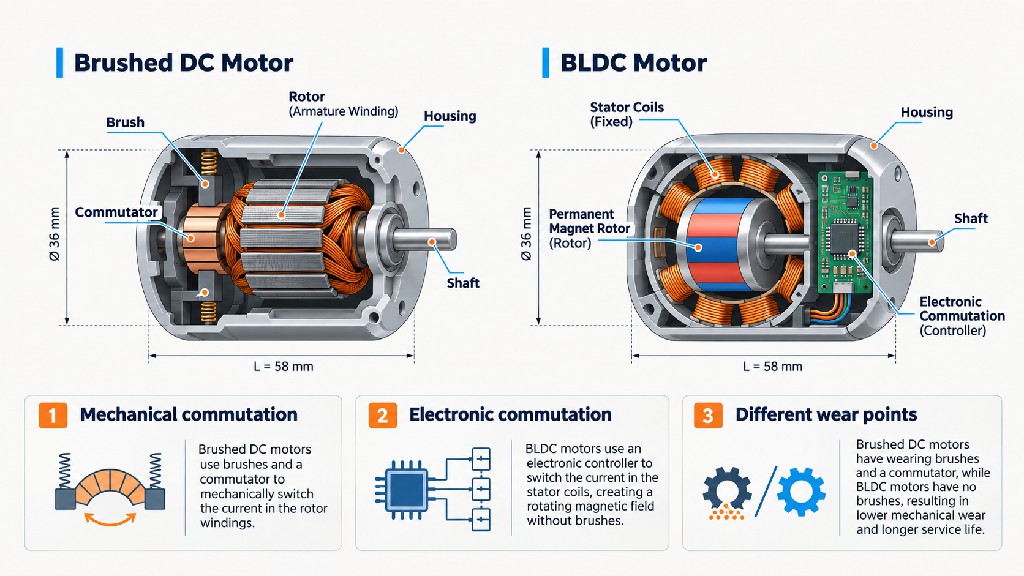
A permanent-magnet brushed DC motor typically has stationary magnets in the housing and an armature winding that rotates with the shaft. Current enters the rotating winding through carbon or precious-metal brushes touching the commutator. As the rotor turns, the commutator changes which winding sections receive current and reverses their polarity at the appropriate point. This mechanical commutation keeps the motor producing torque in the intended direction.
From a system designer's perspective, the architecture is attractive because it is familiar and direct. Supply a suitable DC voltage to a basic permanent-magnet brushed motor and it can rotate without a separate electronic commutation controller. Reverse the polarity and it reverses direction, within the motor's permitted operating conditions. An H-bridge provides electronic reversal and braking; a PWM drive adjusts effective applied voltage and can impose current limits.
The brushes also create compromises. Sliding electrical contact produces friction, electrical contact losses, wear, and possible sparking. Over time, the brush material and commutator surface change. Excessive current, repeated reversals, high speed, temperature, vibration, and environmental contamination may shorten the useful service interval.
Not all brushed motors behave alike. Carbon/graphite brushes are commonly selected to tolerate higher currents and repeated starts, while precious-metal commutation can achieve very low friction and low electrical noise in appropriately loaded miniature motors. These design trade-offs are discussed in .
A key distinction for buyers is whether the motor has replaceable brushes. In a large industrial assembly, brush maintenance may be inexpensive. In a sealed miniature DC motor, there may be no economical way to replace the brushes; the entire motor must be changed. A quotation that promises inexpensive brush maintenance is not useful unless the motor is actually serviceable.
How a BLDC Motor Works: Electronic Commutation
A conventional three-phase BLDC motor generally has a permanent-magnet rotor and stationary copper windings. Rather than routing electrical current through rotating contacts, a controller energizes the stator windings in a sequence that pulls the rotor around. The rotating magnetic field performs the work previously coordinated by the mechanical commutator.
The controller must know, measure, or estimate where the rotor is. Common approaches include:
-
Hall-sensored commutation: Hall sensors report rotor position, often using six-step commutation. It is practical for startup and low-speed operation.
-
Encoder-based control: More detailed position feedback can support demanding speed regulation, positioning, and servo-type functions.
-
Sensorless back-EMF control: The drive infers position from the voltage generated as the motor spins. This can reduce wiring and sensor cost, but ordinary back-EMF sensing becomes difficult near zero speed.
-
Field-oriented control (FOC): Coordinated current regulation can improve smoothness and control over the operating range when implemented and tuned appropriately. It is a control method, not a promise of perfect efficiency or torque.
Texas Instruments describes these sensing and commutation methods in its . It specifically explains why conventional sensorless back-EMF approaches have difficulty at low speeds.
A BLDC system therefore needs commutation electronics, but they do not always require a large external box. The power stage and logic may be integrated inside the motor assembly or a compact driver. Modern integrated drivers have significantly narrowed the complexity difference for OEMs, although power, thermal, and wiring requirements remain. A BLDC motor connected directly to a DC supply without its required electronic commutation circuit will not operate as intended.
Removing brushes eliminates a particular wear mechanism and source of arcing. It does not eliminate bearings, winding insulation aging, magnets, mechanical loading, electronic failures, or environmental degradation. The more responsible question is not, “Does BLDC last forever?” It is, “Which component limits this particular BLDC assembly under our operating conditions?”
What Is the Difference Between Brushed and Brushless Motors in Real Equipment?
For a fixed-speed, lightly loaded mechanism, a two-wire brushed motor may deliver all necessary functionality. A BLDC package may offer no practical benefit if its extra controller cost is large compared with the value of the complete machine.
At the opposite extreme, a motor that runs eight hours every working day accumulates roughly 2,000 hours a year. The risk of repeated brush service, greater thermal loading, lost production, and difficult access can outweigh a lower initial motor price. Even then, the engineer must verify the BLDC controller's life, cooling, and compatibility with the load.
Consider three questions before comparing catalogs:
-
What mechanical output is required? Specify torque and speed together, not watts alone.
-
How will the motor operate? Define starts per hour, reversals, acceleration, overload, continuous running, and annual hours.
-
What does a failure cost? An inexpensive replacement motor in a consumer device is very different from a motor buried inside an automated production line.
These questions turn a generic difference between brushed and brushless motors search into a commercially meaningful engineering decision.
Brushed vs Brushless Motor Efficiency: Compare the Actual Operating Point
The fundamental motor efficiency equation is simple:
Motor efficiency (%) = mechanical shaft output power / electrical input power × 100.
Mechanical output power depends on both torque and angular speed:
Shaft power (W) = torque (N·m) × 2π × rotational speed (rpm) / 60.
For example, a motor delivering 0.50 N·m at 3,000 rpm produces approximately 157 W of mechanical power. A motor rated for “150 W” is not automatically capable of delivering that output continuously at any speed or temperature. Confirm the torque-speed curve, current limit, permissible duty cycle, and thermal rating.
Why BLDC can have an efficiency advantage
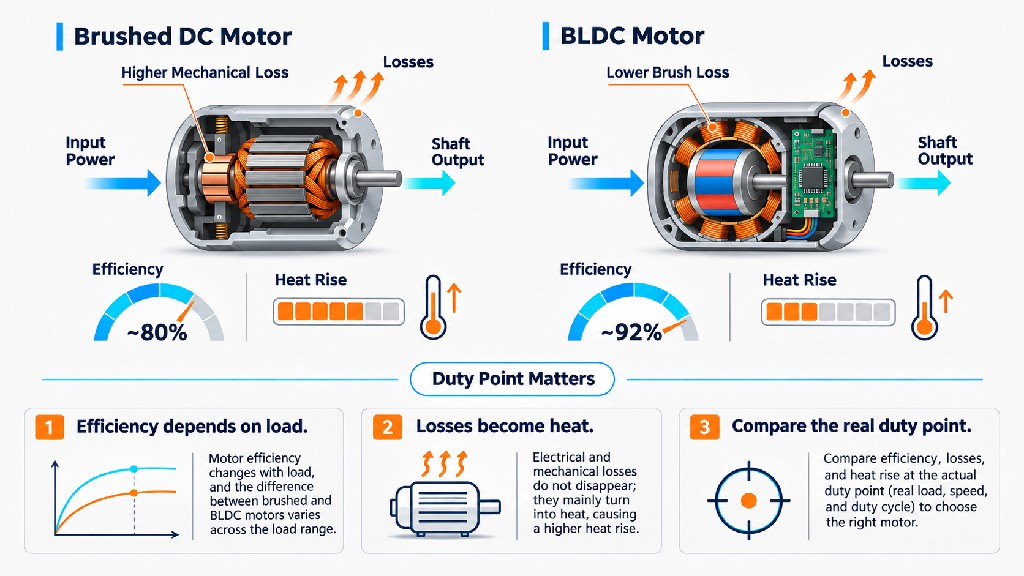
A BLDC design avoids the voltage drop and friction associated with brushes. The stator windings are also often easier to conduct heat away from than windings on a rotating armature. Appropriate electronic commutation can reduce certain losses and support efficient operation over a useful range. For a battery-operated machine, even a moderate efficiency improvement can reduce input current and extend runtime.
However, the BLDC system has losses of its own: MOSFET conduction losses, switching losses, gate-drive and controller consumption, copper resistance, magnetic core losses, and mechanical friction. A poor commutation strategy can produce excess phase current or torque ripple, and an oversized drive may consume disproportionate power at a tiny load.
Why brushed does not automatically mean inefficient
A premium coreless brushed motor with suitable winding and commutation materials can offer excellent performance, especially in a small, short-duty product. Brush design and operating current matter. Compare motors of similar quality and physical size before drawing conclusions; comparing a cheap brushed motor with a premium BLDC motor primarily proves that the products are different.
Likewise, a BLDC motor that achieves high peak efficiency near one speed may be inefficient at another. Low-load and intermittent duty can substantially alter the economics. Manufacturers also quote efficiency at different boundaries: motor-only, motor-and-controller, gearbox output, or entire machine.
A worked efficiency calculation—not a universal rating
Assume two properly sized motor-and-driver combinations each deliver 100 W of continuous shaft power at the same load point. Assume, for illustration, 70% electrical-to-shaft efficiency for the brushed combination and 82% for the BLDC combination.
| Calculated metric | Brushed system: assumed 70% | BLDC system: assumed 82% |
|---|---|---|
| Mechanical output | 100.00 W | 100.00 W |
| Electrical input (100 W / efficiency) | 142.86 W | 121.95 W |
| Approximate system losses | 42.86 W | 21.95 W |
| Input energy over 1,000 operating hours | 142.86 kWh | 121.95 kWh |
| Energy cost at $0.18/kWh over 1,000 hours | $25.71 | $21.95 |
In this example, BLDC saves about 20.91 kWh and $3.76 per 1,000 operating hours. That is meaningful over many motors or many hours, but it is not a reason to pay any price premium for every low-duty device. Both efficiency figures are hypothetical system-level assumptions—not measured specifications for FRANK HU MOTOR products.
When reading datasheets, ask for efficiency at the specified output torque, speed, supply voltage, ambient temperature, and drive configuration. maxon explains in its that motor parameters change with temperature, tolerances, installation, and control approach. The U.S. Department of Energy likewise recommends assessing motor and drive operating conditions rather than assuming catalog efficiency equals system efficiency; see its .
Heat Rise, Power Density, and Continuous-Duty Sizing
Energy that is not converted into shaft work is largely dissipated as heat, with a portion appearing as sound and other losses. Temperature matters because winding resistance increases as copper heats, insulation life depends on thermal stress, lubricant performance changes, and electronics have temperature limits.
A key copper-loss relationship is P(copper loss) = I²R. Doubling winding current at a given resistance increases resistive heating fourfold. This is why prolonged operation near stall can be dangerous even when a motor's nominal wattage seems modest. Stall torque is not the same as safe continuous torque.
BLDC motors frequently achieve attractive power density because of their rotor/stator arrangement and cooling options. But a tiny BLDC motor in a sealed box can overheat despite an impressive catalog power figure. A brushed motor with a larger frame and better heat sinking can be thermally safer for the same duty.
For both technologies, specify mounting surface, airflow, ambient temperature, maximum winding or housing temperature, load inertia, and operating profile. If the application sits beside a furnace, inside a warm enclosure, or above a dusty production line, request a thermal verification test in the actual mechanical installation. Surface temperature alone may not reliably represent hot-spot winding temperature.
Speed Range, Starting Torque, and Low-Speed Control
Both motor types can deliver useful torque from rest, but they do so differently. A brushed motor develops torque according to armature current and motor torque constant. At a standstill there is little or no back-EMF opposing the supply, so an unrestricted start can draw very high current. That may provide strong initial torque, but it also risks overheating brushes and windings, damaging gears, or overstressing the supply.
A BLDC motor produces starting torque when the drive applies appropriate phase currents relative to rotor position. Hall-sensored or encoder-based control can support demanding starts under load. A conventional sensorless back-EMF controller, however, may need an open-loop alignment and startup sequence before reliable position estimates become available. That can be unsuitable for a heavily loaded conveyor, repeatedly reversing actuator, or robotic axis unless the drive's low-speed capability is specifically verified.
Low-speed operation is not the same as precise positioning. A brushed motor with an encoder and a closed-loop controller can be highly controllable. A BLDC motor without position feedback or adequate sensorless estimation is not automatically a precision servo. If the application requires repeatable angular position, a specific hold torque, or safe stop behavior, specify the feedback system, control loop, gearbox backlash, and brake where needed.
| Operating challenge | Practical evaluation |
|---|---|
| Start a loaded belt from rest | Check current-limited start torque and acceleration time |
| Hold position at zero speed | Determine whether a brake or appropriate closed-loop torque control is required |
| Run smoothly at very low rpm | Compare torque ripple, feedback resolution, and gearbox friction |
| Reverse frequently | Test brush wear or drive tuning under the actual reversal profile |
| Operate at high rpm | Verify commutation, rotor balance, bearings, and maximum permissible speed |
| Handle shock or jam | Specify current protection, thermal trip, and mechanical overload behavior |
Where a gearbox is required, choose the ratio from the load torque-speed requirement, not simply the motor's maximum rpm. Output torque rises approximately with ratio and gear efficiency, while output speed falls. Gearbox losses, backlash, and life can dominate the final choice regardless of whether the upstream motor is brushed or brushless.
Brushed vs Brushless Motor Lifespan: What Actually Wears Out?
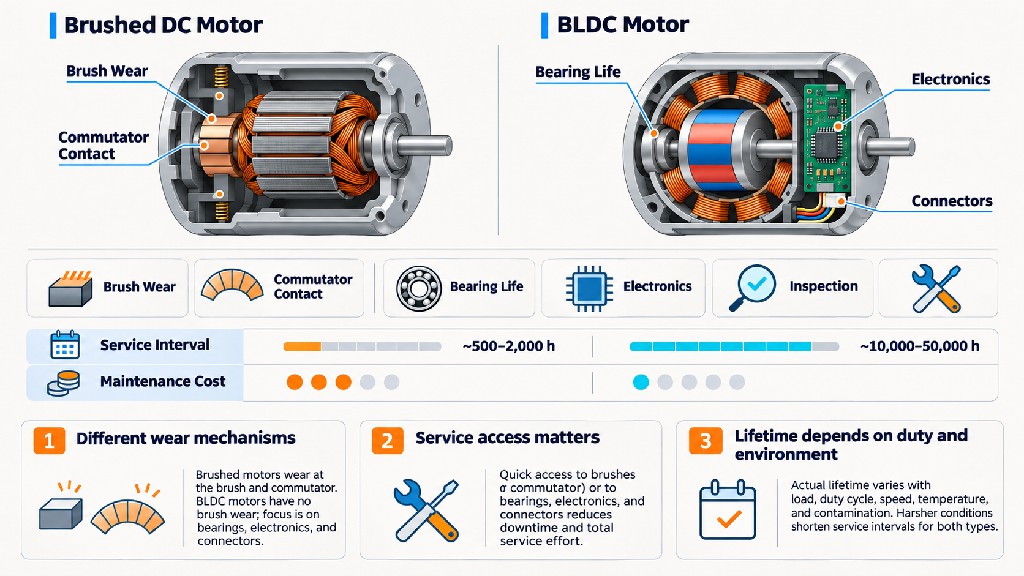
A frequent search is brushed vs brushless motor lifespan. The most misleading answer is a single number with no operating conditions. Brush wear is affected by current, speed, brush material, commutator design, reversing frequency, humidity, vibration, contamination, and start-stop duty. A BLDC motor avoids brush wear but still depends on bearings, lubrication, seals, windings, magnets, connectors, and electronics.
Dunkermotoren reports that its brushed motor service life is typically 1,000–8,000 hours, depending on design and application, while its brushless motor life can extend to several tens of thousands of hours with bearings often becoming the limiting item. These figures are manufacturer-specific context, not universal ratings for every brushed or BLDC motor. See .
Importantly, a carefully matched brushed motor may last longer than a BLDC assembly exposed to poor sealing, excessive shaft loads, repeated overheating, or controller faults. In addition, a bearing-life estimate is a statistical design tool, not a promise that every installed motor will reach a specified hour count.
The operating profile changes the answer
Compare a handheld tool used for 15 minutes per day with a ventilation fan running all day. Even if both have identical nominal motors, five calendar years represent radically different accumulated running hours. Frequent acceleration and reversing can also be more demanding for a brush-and-commutator system than steady rotation at a modest load.
A specification of “five-year service life” should therefore be converted into measurable requirements: total running hours, number of starts, reversal count, duty ratio, ambient conditions, permissible bearing load, and allowed failures over the fleet. For a critical machine, request field data or a qualification plan as well as any nominal life estimate.
Bearings, gears, and the rest of the assembly
Bearings can suffer from incorrect preload, side loading from belt tension, misalignment, unsuitable grease, water intrusion, or abrasive dust. Gearheads introduce additional wear surfaces; a worm gearbox may generate considerable heat and efficiency loss. A BLDC motor paired with a low-quality gearbox cannot be called maintenance-free merely because the motor lacks brushes.
A better reliability discussion identifies the weakest link in the motor + controller + gearbox + sensors + connectors + mounting chain. Ask for permissible radial and axial shaft loads, bearing type, seal protection, grease constraints, vibration testing, and any specified service interval.
Brushless Motor Maintenance vs Brushed Motor Maintenance
The maintenance difference is real but narrower than advertising sometimes suggests. In brushed assemblies, maintenance may include inspection of brush length, commutator condition, unusual arcing, carbon dust, bearing noise, current draw, and terminal connections. For a sealed low-cost motor, the practical action may be complete motor replacement rather than brush servicing.
For a BLDC assembly, removing brush inspection does not remove the need to examine bearing condition, cable insulation, motor mounting, cooling passages, encoder or Hall connections, drive alarms, heat-sink temperature, enclosure seals, or gear lubrication. Maintenance should be based on manufacturer instructions and the severity of the duty.
For procurement, ask for maintenance tasks in minutes per event, parts costs, service intervals, required tools, and whether the work forces a production stoppage. This permits a financial model that separates scheduled labor, consumables, motor replacements, and lost output rather than hiding everything under a vague “maintenance-free” label.
| Maintenance exposure | Brushed DC | BLDC |
|---|---|---|
| Brush inspection or replacement | Possible, depending on design | Not applicable |
| Commutator surface wear | Yes | Not applicable |
| Bearing inspection | Required as appropriate | Required as appropriate |
| Gearhead lubrication and seals | Depends on configuration | Depends on configuration |
| Cable/connector inspection | Required as appropriate | Required as appropriate |
| Controller diagnostics | If a controller is installed | Usually part of the drive system |
| Thermal and vibration monitoring | Valuable for critical duty | Valuable for critical duty |
Electromagnetic Interference and Acoustic Noise
Brushed motors can produce broadband electrical interference when their mechanical contacts switch current, particularly if the commutator arcs. Such interference can disturb nearby sensors, radios, analog measurements, or poorly protected control boards. Snubbers, suitable suppression capacitors, filters, shielding, grounding, and wiring layout may help, but the design should be validated for its actual environment.
BLDC motors remove the brush-arcing source of interference. They are not EMI-free. Their semiconductor inverter rapidly switches current, creating conducted and radiated emissions, voltage transients, common-mode currents, and possible coupling into encoder cables. PWM speed controllers for brushed motors can likewise generate switching-related EMI. Texas Instruments discusses gate-drive slew-rate control and PCB measures for both motor categories in its .
The final result depends on cable lengths, shield termination, grounding, switching frequency, edge rates, enclosure design, motor construction, and the surrounding electronics. A short bench test on a bare motor does not replace EMC evaluation on the finished machine.
Acoustic noise is similarly application-specific. Brushed motors may produce brush and commutator sounds. BLDC systems can exhibit tonal PWM noise, cogging, torque ripple, bearing noise, and drive-induced vibration. A geared motor may be dominated by gear-mesh noise. Smooth electronic commutation, adequate PWM frequency, mechanical damping, and good gear design can help, but neither motor type is inherently silent.
For medical, laboratory, and precision measurement equipment, assess electrical emissions and audible noise separately. An electrically quiet motor may still vibrate enough to disturb a camera or instrument, and an acoustically quiet system may still exceed an EMC limit.
Driver Complexity: What Is Included in the Quotation?
A common mistake is to compare the price of an unpowered BLDC motor with the price of a brushed motor that can run directly from a suitable DC source. These are not equivalent delivered systems.
A basic brushed motor can be controlled with a switch, although many real OEM applications require a PWM controller, H-bridge, current limit, soft-start function, or encoder interface. A three-phase BLDC motor requires electronic commutation and a power stage. Depending on the design, it may also need Hall sensors, an encoder, current sensing, firmware, parameter setup, and fault protection.
The apparent complexity disadvantage of BLDC is smaller when the motor is purchased with an integrated controller. Texas Instruments has demonstrated compact sensored driver architectures that reduce the interface to high-level commands rather than requiring an OEM microcontroller to calculate every switching event. See its for the underlying control architecture.
Ask the supplier to identify whether the quoted item is (1) a bare motor, (2) motor plus external driver, or (3) an integrated motor-drive unit. Then confirm the following before approving the BOM:
-
Supply voltage range, continuous and peak phase current, and protective derating.
-
Hall/encoder compatibility, sensorless starting method, and minimum controllable speed.
-
Speed-command interface: PWM, analog input, serial communications, fieldbus, or a simple direction input.
-
Overcurrent, overtemperature, undervoltage, stall, and restart behavior.
-
Regenerative energy handling during braking or lowering of a vertical load.
-
Cable length, connector pinout, EMC provisions, configuration software, and spare-part availability.
A safety distinction: Electrical braking is not necessarily a holding or emergency-stop safety function. Vertical axes and stored-energy mechanisms may need a suitable mechanical brake or independently engineered safety system. Do not infer a safe holding capability from a driver's “brake” command.
Brushless DC Motor Cost: Purchase Price Is Only the Beginning
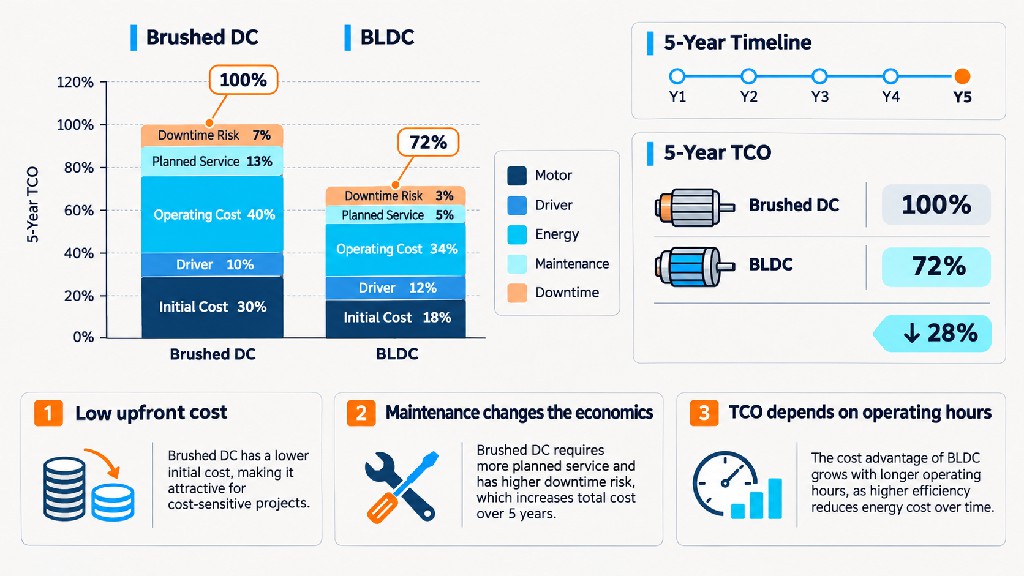
A purchasing comparison should contain at least four separate categories: motor acquisition, driver or controller acquisition, maintenance and replacement, and downtime or lost production. Electricity is a fifth category that becomes increasingly important with high operating hours or large motor fleets.
Other costs can matter too: engineering integration, harnesses, sensors, regulatory testing, tooling changes, spares, freight, warranty service, and inventory. The first two are easy to see on a quotation. The others are often where a decision changes.
For instance, a brushed motor that costs 25 less can be attractive for a battery-powered retail item operating only a few hundred hours over its entire life. But an accessible 25 brush-service job is not the same as a two-hour shutdown of a packaging line. Conversely, if a brushed motor is already proven to complete the equipment's life with no servicing, paying a large BLDC premium solely to eliminate brushes may not make financial sense.
Do not apply one advertised motor-price ratio to every power class. A miniature coreless brushed motor, a mass-produced fan BLDC motor with an integrated driver, and an industrial BLDC servo-like package may have very different cost structures. Request price breaks for the real annual quantity and include qualified alternatives.
Five-Year Total Cost of Ownership: Worked Buying Example
The following example provides a reproducible calculation for a hypothetical OEM mechanism delivering a steady 100 W of shaft output whenever it operates. Both options are assumed to meet the same mechanical and safety requirements. All dollar amounts are invented planning assumptions, not product quotations, published energy tariffs, field failure data, or warranty commitments.
Step 1: Set the common operating assumptions
| Input | Assumption | Why it matters |
|---|---|---|
| Evaluation period | 5 years | Commercial ownership window |
| Working days per year | 250 | Industrial example; not a universal calendar |
| Mechanical shaft output while running | 100 W | Same delivered work for both alternatives |
| Brushed system electrical-to-shaft efficiency | 70% | Assumed motor-plus-drive value at this load point |
| BLDC system electrical-to-shaft efficiency | 82% | Assumed motor-plus-drive value at this load point |
| Electricity price | $0.18/kWh | Illustrative blended rate |
| Downtime opportunity cost | $70 per lost hour | Incremental business loss; excludes the service labor counted below |
| Inflation, discounting, taxes, and disposal | Excluded | Simplifies a first-pass nominal-dollar comparison |
The model assumes a constant 100 W mechanical demand during all logged running hours. It excludes idle energy, battery charging losses, power-factor effects, auxiliary cooling, and load variation. A real quotation analysis should replace these inputs with measured values and include any material costs omitted here.
Step 2: Separate motor, drive, and service costs
| Cost assumption | Brushed solution | BLDC solution |
|---|---|---|
| Motor purchase | $50 | $90 |
| Driver/controller purchase | $15 | $50 |
| Initial installed hardware subtotal | $65 | $140 |
| Planned maintenance trigger | Every 3,000 running hours | Every 5,000 running hours |
| Maintenance parts and labor per event | $25 | $20 |
| Lost production time per event | 1.5 hours | 0.5 hours |
| Downtime cost per event at $70/hour | $105 | $35 |
| Combined maintenance and downtime per event | $130 | $55 |
For the brushed solution, a maintenance event represents inspection and service of a hypothetically replaceable brush assembly. If a real motor is sealed or non-serviceable, the model must instead include whole-motor replacement, fitting, and commissioning. For the BLDC solution, an event represents bearing/connection/drive inspection. It does not assume the BLDC motor or controller is guaranteed to survive five years.
Events scheduled exactly at the end of the five-year ownership period are excluded, because the equipment is assumed to leave the evaluation window at that moment. Neither technology is assumed to suffer an unscheduled failure in the base case. This restriction is important: the model compares planned costs, not statistically expected reliability costs.
Step 3: Calculate energy at equal mechanical output
For each motor system:
Electrical energy (kWh) = [shaft power (kW) / combined system efficiency] × operating hours.
Energy cost = electrical energy × electricity price.
With 10,000 operating hours over five years:
-
Brushed: (0.100 / 0.70) × 10,000 = 1,428.57 kWh, or $257.14.
-
BLDC: (0.100 / 0.82) × 10,000 = 1,219.51 kWh, or $219.51.
-
Difference: approximately 209.06 kWh and $37.63 in electricity savings for BLDC.
The BLDC energy advantage is real within these assumptions, but it accounts for only part of the five-year ownership difference. Maintenance and downtime dominate this particular industrial example.
Step 4: Compare three daily duty cycles
The same mechanism may be used in very different ways. Assume the following average actual powered running times, not just hours that a factory is open.
| Five-year scenario | Running time | Brushed service events | BLDC inspection events |
|---|---|---|---|
| Light duty: 0.5 hour/day × 250 days/year × 5 years | 625 h | 0 | 0 |
| Medium duty: 2 hours/day × 250 days/year × 5 years | 2,500 h | 0 | 0 |
| High duty: 8 hours/day × 250 days/year × 5 years | 10,000 h | 3 | 1 |
The number of events is derived from the assumed intervals, excluding a service due precisely at the end of the period. No assumption about an actual product's brush life should be inferred from this schedule.
Step 5: Show each cost separately for the high-duty case
| Five-year cost component: 10,000 h | Brushed DC | BLDC |
|---|---|---|
| Motor acquisition | $50.00 | $90.00 |
| Driver/controller acquisition | $15.00 | $50.00 |
| Electricity | $257.14 | $219.51 |
| Planned maintenance parts and labor | $75.00 | $20.00 |
| Planned downtime | $315.00 | $35.00 |
| Five-year total | $712.14 | $414.51 |
Illustrative BLDC five-year saving: $297.63 per operating mechanism. This is not a forecast. The saving follows from the assumed operating hours, planned maintenance schedule, and the $70/hour lost-production rate. If a machine is serviced during an already planned shutdown, some or all of the calculated downtime penalty may disappear.
Step 6: Compare total cost at three utilization levels
| Five-year running hours | Brushed TCO | BLDC TCO | Lower-cost solution under the assumptions |
|---|---|---|---|
| 625 h | $81.07 | $153.72 | Brushed, by $72.65 |
| 2,500 h | $129.29 | $194.88 | Brushed, by $65.59 |
| 10,000 h | $712.14 | $414.51 | BLDC, by $297.63 |
The main insight is not the last dollar. The better financial decision changes with utilization and the cost of stopping the equipment. At low running hours, this hypothetical brushed system wins because it avoids the $75 initial hardware premium. At high hours, repeated service and lost output reverse the result.
Step 7: Test sensitivity before making the purchasing decision
A credible model must show which assumptions could change the recommendation.
If downtime has no incremental cost, remove the downtime line while keeping maintenance labor and energy. At 10,000 hours, the revised totals are approximately $397.14 for brushed and $379.51 for BLDC—only $17.63 apart. In other words, most of the base-case advantage disappears.
If a qualified brushed motor needs no brush service during the evaluation window, do not invent service events. Under the model's remaining assumptions, the brushed option would cost $322.14, versus the base BLDC total of $414.51, making brushed $92.37 less expensive. This scenario assumes the brushed unit really can meet the life requirement; it must be supported by evidence.
If the machine's load varies, replace the constant 100 W calculation with a duty-weighted energy model. A fan might spend much of its life at partial speed, while a positioning device might draw short acceleration peaks followed by long idle periods. Measure both systems over the representative duty cycle.
If a failure stops a critical process, planned maintenance alone is insufficient. Add a probability-weighted allowance for unexpected failures, repair time, restart scrap, and contractual penalties. Do not fabricate field failure probabilities just to make one technology appear cheaper.
A useful purchase spreadsheet can follow the same structure:
Five-year TCO = initial motor + initial controller + electricity + planned maintenance + planned downtime + replacement cost + risk-adjusted unplanned downtime + other relevant lifecycle costs.
For large fleets, multiply the per-unit costs by the number of operating machines, then assess installation or engineering costs that occur only once. If expenses occur in different years, a discounted cash-flow or net-present-value model is preferable to simple addition.
Application Guide: Which Motor Makes Sense for Your Product?
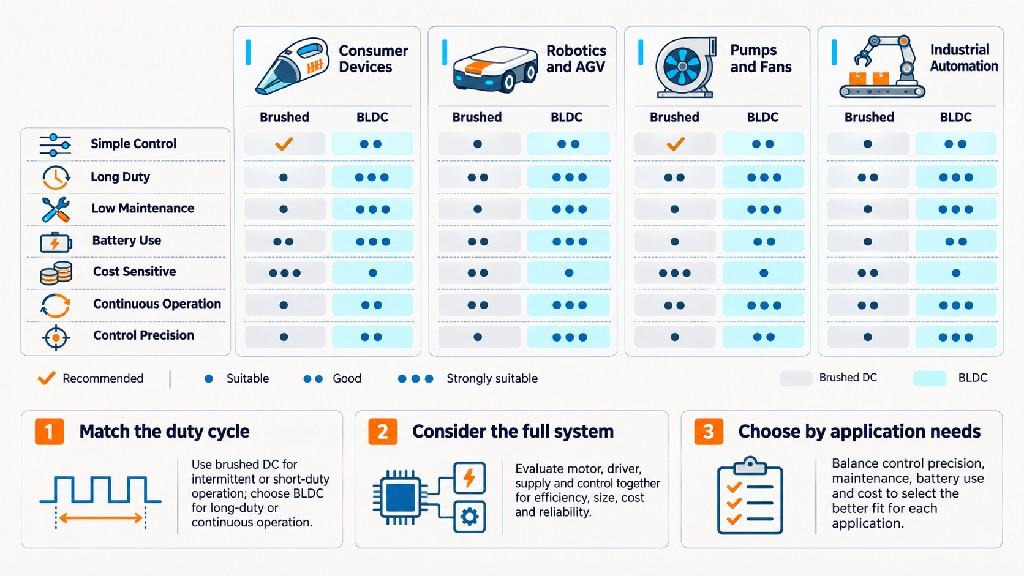
The following are starting recommendations, not substitutes for motor sizing and qualification. Each industry includes designs where either technology can win.
Low-power devices and occasional-use consumer products
For a toy, small adjustable mechanism, short-cycle dispenser, handheld accessory, or simple home appliance, a brushed DC motor may be the economical choice. Two-wire integration can reduce BOM cost, assembly time, and engineering risk. If the device accumulates only a few hundred operating hours, brush replacement may never become relevant.
BLDC becomes attractive when the same compact device needs low heat, long battery runtime, very high speed, a premium noise target, or sustained operation. Do not assume a brushless solution will save money merely because it is described as higher-end. Consider whether the electronic controller, Hall cable, and additional validation fit the bill of materials and manufacturing process.
Robotics, AGVs, and mobile platforms
For brushed vs brushless motor for robotics, first distinguish a simple driven wheel from an actively controlled robotic joint. A low-cost educational robot or intermittent mobile platform can work well with brushed gearmotors, wheel encoders, and an H-bridge. A commercial AGV that travels for many hours each day may benefit from BLDC efficiency, long service intervals, feedback integration, and robust fault monitoring.
An encoder-equipped brushed motor can close a speed or position loop; “brushed” does not mean “open loop.” Likewise, a BLDC traction motor is not automatically a precision servo. AGV designers must verify acceleration torque, grade-climbing requirements, wheel diameter, battery voltage sag, regenerative braking, gearhead ratio, and safe stop behavior. Wheel traction, load distribution, and control software often influence performance as strongly as the motor category.
For robotic joints, low-speed smoothness, torque ripple, reduction ratio, stiffness, backlash, and thermal behavior matter. A high-efficiency BLDC motor with an inappropriate reducer can still produce a poor positioning axis. If high-bandwidth position control is required, evaluate a complete servo architecture rather than choosing solely from a brushed/brushless label.
Pumps and fans
Continuously running fans and centrifugal pumps are common BLDC candidates because operating hours accumulate rapidly. Electronic speed control can also reduce energy demand when actual airflow or flow requirements vary. For centrifugal equipment operating under conditions where the affinity laws apply, power demand can fall markedly as speed is reduced; system curves and static head can alter the result, so do not apply a universal cubic-law saving to every installation.
Brushed motors can still be reasonable for intermittent pumps, portable inflation devices, emergency actuators, and budget-sensitive equipment. A pump's seals, fluid contamination, cavitation risk, and bearings may determine service life before the motor does. A fan's impeller balance, dust loading, and bearing quality can have the same effect. Test the complete rotating assembly rather than the bare motor alone.
CNC equipment and industrial automation
Small auxiliary mechanisms—accessory positioning, clamping, doors, dispensing, and material handling—may use either brushed or BLDC motors. The choice depends on duty, required force, controls, and integration. For a continuously operating conveyor or production handling mechanism, BLDC control and lower brush-related maintenance can be valuable. For an inexpensive, easily accessible mechanism that operates infrequently, a brushed motor may remain the rational selection.
Do not confuse these motors with CNC spindle, stepper, or servo-axis requirements. A precision feed axis may need closed-loop servo control, a brake, a specific encoder, and documented dynamic performance. A BLDC motor alone does not deliver these functions automatically.
Laboratory, medical-adjacent, and precision instrumentation
Miniature brushed coreless motors can offer low rotor inertia and smooth operation for compact mechanisms. Sensor-equipped BLDC motors are attractive where long running periods, reduced brush particulate, and controlled speeds are important. The deciding constraints may involve sterilization, acoustic emissions, vibration, cleanability, or component traceability.
For regulated medical use, a generic motor listing is not evidence of finished-device compliance. The equipment manufacturer must conduct applicable risk management, electrical safety, EMC, cleaning, and validation activities. A motor's general certification or material declaration does not certify the medical device.
Real FRANK HU MOTOR Catalog Examples—and How to Compare Them Responsibly
FRANK HU MOTOR carries both and , allowing engineers to evaluate different constructions within one sourcing workflow. The following examples demonstrate how to read a product listing; they are not direct drop-in equivalents.
-
Brushed example: . Its listing identifies a two-lead motor, nominal 24 V supply, 0.02 N·m rated torque, and a rated speed of 2,300 rpm. The listed no-load speed is 3,500 rpm. The fact that a listing also includes a wattage label does not replace its torque-speed curve or continuous-duty rating.
-
BLDC example: . This larger motor is listed around the 65 W class, with a specified 0.2 N·m and 3,000 rpm. It serves a substantially different load class and cannot be used as a matched efficiency comparison against the small brushed example.
Other relevant categories include and . An integrated-drive design or a geared assembly can simplify installation, but ask precisely which controller, gearbox, protection features, and feedback devices are included in the supplied configuration. Do not assume a controller is included from the category name alone.
Important catalog-reading check: Some product listings show both rated and no-load speed. These are not interchangeable. To estimate mechanical shaft power, use a torque and speed that refer to the same operating point. If a wattage label appears inconsistent with a simple torque-speed calculation, request the manufacturer's full datasheet and test conditions before using the number in a design or published comparison.
A Practical Motor Selection Workflow for Engineers and Buyers
1. Define the mechanical duty in numbers
Write down continuous torque, peak torque, operating speed, minimum controllable speed, maximum permissible acceleration, load inertia, start frequency, reversal frequency, and required service life. For geared motors, distinguish motor-shaft values from gearbox-output values. Include any axial or radial force applied to the shaft.
2. Establish the electrical and environmental constraints
Specify DC bus voltage range—including battery voltage sag—allowable input current, controller space, cooling, ambient temperature, dust and liquid exposure, cable lengths, and EMC requirements. Determine whether the mechanism needs feedback, braking, diagnostics, or remote configuration.
3. Shortlist technically viable alternatives
Request a brushed and a BLDC solution only if both can satisfy the same duty. Compare continuous performance first, then peak operation, size, efficiency, and noise. Eliminate any choice that needs sustained stall operation or exceeds its thermal limit; a low quote is not a bargain if the design is nonviable.
4. Request matched operating-point evidence
A supplier should be able to identify test conditions for speed, torque, input current, output power, and efficiency. Ask whether the plotted curves represent a bare motor or motor plus driver, whether the product was hot or cold, and what controller was used. For frequent reversals or sensorless starts, request evidence under the actual motion profile.
5. Evaluate maintenance and total cost
Translate service intervals into the hours expected over the product's life. Ask whether the brush assembly can be replaced or whether the whole motor must be swapped. Assign a realistic downtime value, but do not count ordinary scheduled shutdowns as lost production unless they actually cause a loss.
6. Test samples in the final equipment
Measure supply input energy, output torque-speed behavior, hot-case performance, audible noise, vibration, start success rate, EMC behavior, and fault recovery. Repeat enough cycles to reveal intermittent issues. A benchtop motor comparison may miss gearbox losses, long cables, enclosure heat, or battery sag.
7. Approve a documented configuration
Record motor and controller part numbers, firmware revision if relevant, gearbox ratio, Hall or encoder pinout, cable harness, protective limits, drawing revision, acceptance-test criteria, supplier lead time, and spare-parts plan. This protects the engineering result when purchasing moves from prototype quantities to production.
RFQ Checklist: What to Send the Motor Supplier
To obtain a useful quotation from , include these details in your inquiry rather than asking only for a motor of a certain wattage:
| RFQ field | Example of a useful requirement |
|---|---|
| Application | Compact conveyor drive in indoor packaging equipment |
| Electrical source | 24 VDC nominal, specify minimum and maximum bus voltage |
| Shaft output | Continuous torque and speed, plus peak transient torque |
| Motion profile | Number of starts and reversals per hour; acceleration time |
| Duty cycle | Actual operating hours/day, days/year, and project life |
| Control requirements | Speed regulation tolerance, positioning, feedback, and interface |
| Mechanical envelope | Body diameter/length, mounting face, shaft size, allowable forces |
| Gear requirements | Output speed/torque, ratio, backlash, and acceptable noise |
| Environment | Ambient range, humidity, dust, IP protection, vibration |
| Compliance | Product-specific evidence for applicable markets and standards |
| Commercial quantities | Prototype units, expected annual volume, target delivery dates |
| Documents needed | Dimensioned drawing, torque-speed curve, wiring, STEP file, test conditions |
Useful questions for the supplier include: What is included in the price? What is the continuous rating at our ambient temperature? What are the conditions behind the claimed efficiency and lifetime? Can the motor be serviced? What happens during an overload or failed sensor? These questions reduce the risk of selecting a motor based on an attractive but incomplete product headline.
Frequently Asked Questions
Is a brushless DC motor always more efficient than a brushed DC motor?
No. BLDC often has an efficiency advantage because it eliminates brush-contact losses and may offer favorable thermal construction. But efficiency depends on winding design, size, speed, load, commutation, temperature, and driver losses. High-quality coreless brushed motors can also be very efficient. Ask for efficiency measured at the same torque-speed point and the same system boundary.
Which motor has a longer lifespan: brushed or brushless?
BLDC normally avoids the brush and commutator wear that can limit brushed motors, making it attractive for extended operation. However, its bearing, electronics, insulation, and environmental limits still matter. There is no universal service-hour promise for either type. Use application-specific data, a verified operating schedule, and an appropriate maintenance strategy.
Do BLDC motors require maintenance?
Yes, potentially. They do not require brush replacement, but bearings, seals, gearboxes, connectors, cooling paths, mounting hardware, and controllers still require attention according to the application and manufacturer instructions. “Brushless” and “maintenance-free” are not synonyms.
Can I connect a BLDC motor directly to a 12 V or 24 V DC supply?
Only if the purchased assembly includes the appropriate electronic commutation circuitry and the manufacturer specifies a suitable DC supply interface. A typical bare three-phase BLDC motor needs a compatible driver. Check the wiring diagram; do not assume the presence of a two-wire-style DC input.
Which has better starting torque?
Both can produce substantial starting torque when properly designed and driven. A brushed DC motor can draw very high current at standstill, so starting current must be limited to safe levels. A Hall-sensored or encoder-controlled BLDC system can also produce controlled torque from zero speed. Conventional back-EMF sensorless starting may be less reliable under heavy initial load unless the drive is engineered for it.
Are brushless DC motors quieter and free of electromagnetic interference?
Not necessarily. Eliminating brush arcing removes one noise and EMI source, but BLDC electronics create switching transitions and may introduce torque ripple or audible tones. Brushed PWM drives also switch current. Evaluate actual acoustic noise and EMC emissions in the completed equipment with its real wiring, gearbox, and enclosure.
Is BLDC worth the higher price for a battery-powered robot?
Often, but not automatically. Compare energy consumption over the robot's real drive cycle, payload and acceleration requirements, battery voltage, controller standby power, and expected running hours. A frequently used commercial AGV may gain meaningful value from a well-matched BLDC system. A low-use educational robot may be less expensive with a brushed geared motor and encoder.
How do I calculate whether BLDC pays for itself?
Estimate the initial hardware premium, then calculate energy, service, replacement, and lost production over a defined period. Use the same mechanical output and duty for both options. In the five-year example above, brushed is cheaper at 625 and 2,500 hours, while BLDC wins at 10,000 hours because the assumed maintenance and downtime costs accumulate. Recalculate using your own measurements and repair economics.
Which motor should I choose for a small pump or fan?
Start with running hours, required flow and pressure, start behavior, environmental sealing, and electricity cost. BLDC is commonly attractive for continuous-duty and variable-speed designs, but an intermittent pump may work well with brushed technology. Evaluate the entire pump or fan assembly, including bearings, impeller, seals, and drive losses.
Does a brushless motor automatically give better speed or position control?
No. BLDC commutation is electronic, but useful speed or position accuracy still depends on sensors, control loop design, driver capability, and mechanical transmission. A brushed motor with an encoder can be tightly controlled. For precision industrial axes, compare the complete closed-loop architecture rather than a motor label alone.
Final Recommendation: Choose the Lowest-Risk Complete System
The best answer to BLDC vs brushed DC motor depends on what the equipment must deliver—not which motor category sounds more advanced.
For light-duty and easily serviced products, brushed DC motors offer simplicity and frequently the lowest initial cost. For demanding duty, limited service access, extended running hours, or sophisticated electronic control, a correctly engineered BLDC system is often worth shortlisting. Yet BLDC is not automatically more efficient at every operating point, and it is not guaranteed to outlast every brushed design. Bearings, controllers, environmental exposure, and thermal loading can reverse simplistic assumptions.
A responsible selection process compares equivalent mechanical work, uses measured efficiency where possible, validates starting and low-speed control, and accounts for acquisition, maintenance, energy, and lost production. It also tests the motor in the finished equipment.
Explore FRANK HU MOTOR's and categories, then for a configuration-specific discussion. A complete technical request is the fastest way to compare both solutions fairly and obtain a quotation that remains useful beyond the prototype stage.